A PRACTICAL WORKFLOW · OCTOBER 25, 2026
What should you put in the generator?
Use the name the person wants read aloud, in their own spelling. Preserve accents, spaces and punctuation in the display name. Do not silently replace a name with an English equivalent. If a form has technical restrictions, keep a separate pronunciation hint rather than treating a changed spelling as the person's actual name.
The main PhoneticLab tool accepts English text and includes some names in its dictionary. A match provides a dictionary reading, not evidence about the individual in front of you. An unlisted result is a limit of the dictionary. It does not mean the name has no pronunciation, is misspelled, or should be changed.
A card that makes uncertainty visible
The card builder keeps three things apart: the written name, a reader-friendly hint, and an optional context. The confirmation box changes the label from “Draft — ask the person” to “Person-confirmed reading.” That label is based on your checkbox, not an independent verification by PhoneticLab. Leave it unchecked until you have actually checked.
The card intentionally does not add a country flag or infer a language from a surname. Those shortcuts can suggest an identity or a reading that the person has not chosen. If language matters to the requested pronunciation, ask and enter it in the context field. The same person may choose different readings in different settings.
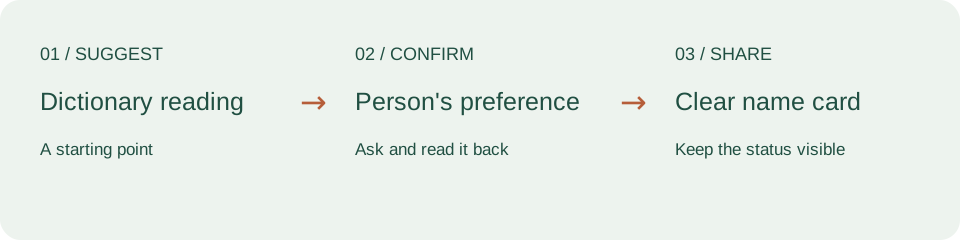
Use this handoff script
Ask: “How would you like me to say your name when I introduce you?” Listen to the full name before writing a hint. Read your attempt back and ask whether the stress and sounds match what they want. If they prefer a recording, ask which way of sharing it is comfortable for them; this page does not record or host audio.
Then ask a reader who has not heard the name to use the card. If the reader pauses, ask which part is unclear and revise that part with the name's owner. This checks the instructions on the card rather than testing the person's name. Do not publish a person's name, pronunciation or recording without their permission.
Choose the right kind of output
| You need | Use | Check before sharing |
|---|---|---|
| A linguistic transcription | IPA from a reliable source or a qualified speaker | Which pronunciation and accent does it represent? |
| A quick introduction | A plain-letter hint the person approves | Can the intended reader understand the hint? |
| The person's exact preferred sound | A recording they consent to share | Will the recipient be able to play it? |
| Letters over a noisy call | A spelling alphabet | It identifies letters, not how the name sounds |
When the dictionary and the person disagree
Keep the person's requested reading on their card. A dictionary describes established uses; it cannot determine a family's preference. An English voice may also replace sounds it cannot reproduce. Changing the voice may change the audio without changing the selected dictionary transcription, so listening is not a proof that an IPA variant was read.
If you need technical IPA for a name outside the supported dictionary, get a qualified transcription for that language. Do not convert an improvised English hint back into IPA and call it exact. For everyday introductions, a clear approximation agreed with the person can be more useful than technical symbols the reader does not know.
Questions before you copy
Does this generate the correct pronunciation of any name?
No. The main tool can suggest dictionary readings for listed names. This page creates a card from your supplied hint and makes its confirmation status explicit.
Can I use it for names from any language?
You can type Unicode names and your own hints into the card. That is text formatting, not automatic transcription or language support. The IPA tool currently supports English dictionary transcription.
Is the card saved?
No history is stored by this card builder. Copy and print work only when you request them. Closing or refreshing the page discards the fields.
Can I put the card in an event program?
Ask the person first, check the event's required format and verify the final proof. Printing this card does not send it to an event organizer.
Method: this page's card workflow, status labels and handoff script were designed for PhoneticLab. They are practical guidance, not a claim that a name has one universal pronunciation.