Why can IPA return more than one English word?
IPA represents pronunciation, while English spelling can distinguish words that sound alike. A pronunciation alone cannot establish a word's meaning or tell you which homophone the writer intended. Read the surrounding sentence before choosing a spelling.
To go in the other direction, use our English text-to-IPA translator. For symbol definitions, consult the International Phonetic Association's chart.
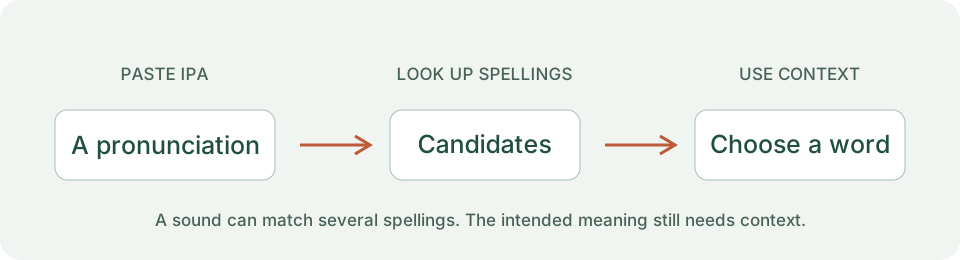
A lookup that keeps uncertainty visible
This tool reverses the English dictionaries already used by PhoneticLab. Each candidate is an existing spelling attached to a matching dictionary pronunciation. It does not invent a word when no entry matches, and it does not rank candidates by their likelihood in your sentence.
Try the homophone example. The result keeps all matching spellings together instead of silently selecting one. Playback stays unavailable until you choose a spelling for every ambiguous word, so a spoken result cannot conceal an unresolved choice.
Run a simple handoff check
Use the two-word example and check that each IPA word has its own result card. If one part has no match, keep that part unresolved rather than treating the remaining words as a complete answer. The page does not infer word boundaries inside a continuous IPA string.
Copy candidates after looking up an ambiguous input. The copied note includes the accent, the IPA, the candidate spellings and the ambiguity warning. It is designed to preserve the question for the next reader rather than make an uncertain answer look final.
What gets normalized?
The lookup removes surrounding slashes or brackets and syllable dots. With “Ignore stress marks” selected, it also ignores primary and secondary stress. It treats the two written forms g and ɡ alike. Other sound symbols and vowel-length marks remain significant; this is not fuzzy sound matching.
An unmatched input can reflect a different accent, a different transcription convention, a missing dictionary entry or a symbol difference. Changing the dictionary is a way to check another declared variety, not a guarantee that one accent must contain your word.
Questions about IPA to English
Does this translate an IPA sentence into its meaning?
No. It finds dictionary spellings for space-separated IPA words. It cannot resolve grammar, meaning or homophones automatically, and it does not translate non-English speech.
Can I upload a recording?
No. This page accepts IPA text. It does not recognize speech or produce a transcription from audio. Use a verified transcription of the recording before trying a reverse lookup.
Where does the dictionary come from?
The bundled English IPA data comes from the MIT-licensed ipa-dict project, the same data used by our forward tool. The dictionary license is included. Coverage and notation vary between the American and British data; no complete-vocabulary guarantee is made.
Is the chosen word's audio a reading of the IPA?
No. Your browser reads the selected English spelling. Its reading can differ from the IPA, especially for words with several pronunciations. Review the text with our phonetic transcription worksheet, and confirm personal name readings with the person.