What does an IPA transcription tell you?
The International Phonetic Alphabet provides symbols for representing speech sounds. A transcription is a choice of sounds and detail for a particular purpose. It is not a translation of a sentence's meaning, and changing English spelling into symbols does not settle which pronunciation a speaker intended.
For symbol reference, use the International Phonetic Association's official chart. A chart can help identify a symbol. It cannot decide the intended meaning of an ambiguous word, supply a missing recording, or confirm an individual's name pronunciation.
Our review note keeps uncertainty attached
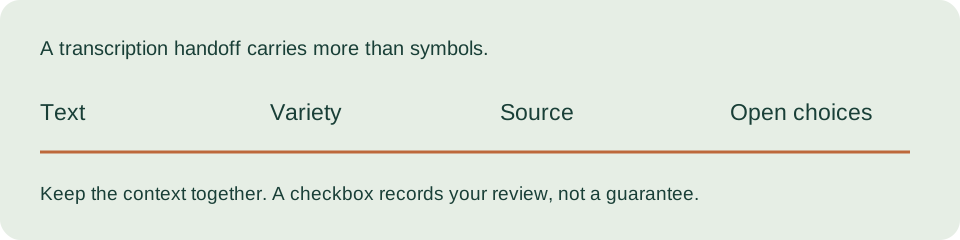
The note begins with either “Unreviewed source check” or “Source check recorded by user.” Selecting the checkbox records your own statement. PhoneticLab does not contact the source, listen to speech or independently certify the transcription. Copying the note carries that distinction into the handoff.
Unresolved choices remain in a separate field even when the source checkbox is selected. A source may cover most of a passage while leaving a name or a context-sensitive word open. The form deliberately does not turn the entire passage green or award a correctness score.
Run this handoff test
Write down the passage's purpose before choosing its notation. A reader preparing a presentation needs a usable pronunciation guide; a researcher describing a recording needs an account of the speech actually observed. Tell the recipient which task your transcription serves instead of letting the alphabet imply a level of detail you have not checked.
Give the recipient the review note alongside the transcription. Ask them which accent and source it represents, and which words remain unresolved. If they cannot answer from the note, revise the missing field. This tests the clarity of the handoff, not the linguistic accuracy of the symbols.
Phonetic transcription or phonemic transcription?
Broad phonemic transcription usually uses slashes and represents sound contrasts; a narrower phonetic transcription commonly uses square brackets and can include finer detail. Adding brackets around dictionary output does not create a narrow transcription. For a recording-based task, the detail must come from the recording and a suitable analysis.
The same written word may need a different reading in a different sentence. Before copying a dictionary suggestion, check the intended meaning and grammatical role. If your task depends on connected speech, do not assume a list of isolated-word readings captures everything a speaker does across word boundaries.
A reproducible worksheet check
Try a non-personal task label, an accent label and a reference label. Leave the checkbox off, build the note and check that it says “Unreviewed source check.” Then select the checkbox and build again. The new status must say who made the check rather than claiming automatic verification.
Finally add an unresolved item and copy the note. The copied text should retain that item along with the source and accent. Refreshing this page clears the form; it does not create a saved project. Keep your own permitted copy if you need to return later, and avoid putting private recording links in a note you intend to share publicly.
Questions before you share
Does this generate IPA automatically?
No. The main English tool generates dictionary suggestions. This page helps you document a review and preserve the context of a transcription you are already working with.
Can this check an audio recording?
No audio is uploaded or analysed by this worksheet. A completed note is not evidence that a recording has been transcribed or assessed.
Is a checked note guaranteed correct?
No. The status records your checkbox selection. Accuracy still depends on the source, the intended reading and the review you actually performed.
How should I handle a person's name?
Ask the person for their preferred reading. Our name card workflow keeps that confirmation separate from a dictionary suggestion.